
Show/hide bandcamp audio player
Links will open in a new tab
It Makes Us Sad is The Grim’s first album.
It made its weary way into the big wide world in August 2007. It was my response to a challenge that I set myself – namely, to release an album called ‘It Makes Us Sad’ by a band called ‘The Grim’. I thought that would be the end of it.
How wrong I was.
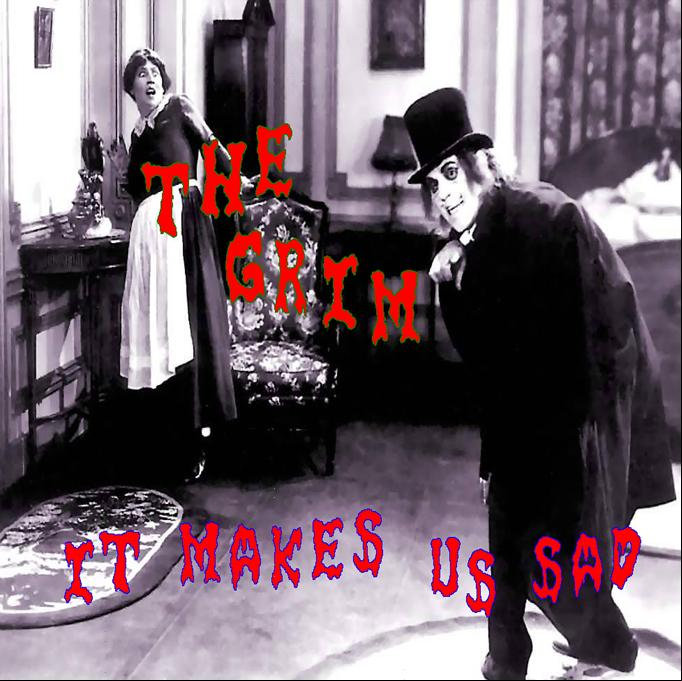
The album cover features Lon Chaney in stills from London After Midnight, a lost horror film from 1927. The last known copy of the film was destroyed in the MGM vault fire of 1965. It looks rather fun doesn’t it!
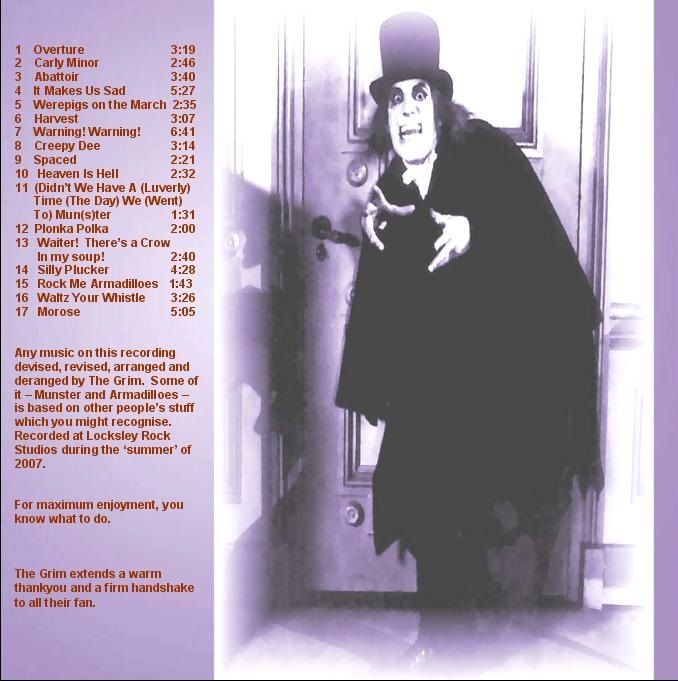
I made up some gibberish for the inside of the CD booklet, just to make it look like there was a band involved somewhere.
I don’t think I fooled anyone.
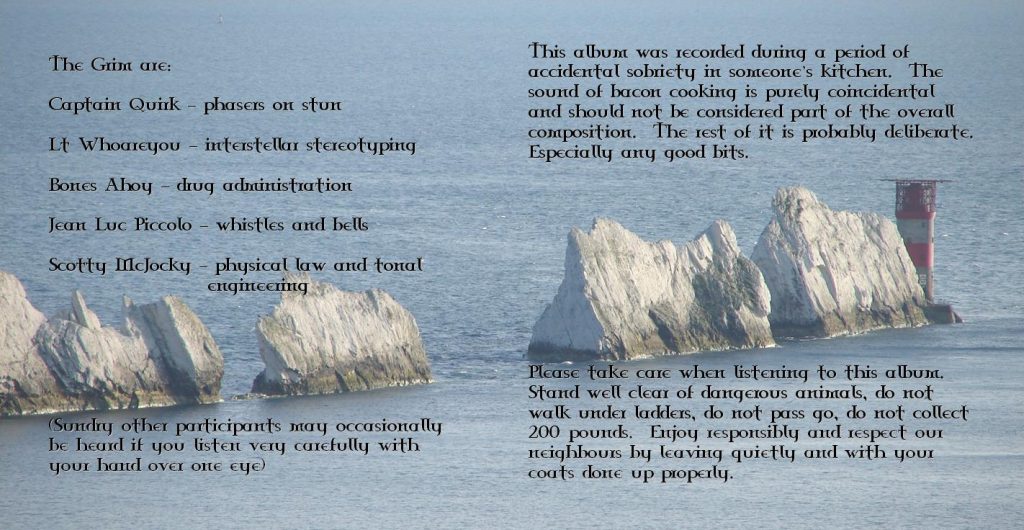
Incidentally, I took that photo of the needles and lighthouse by myself, with my own camera, and my own eyes, when I was wandering the Isle of Wight coast with Katy in July 2007; turned out nice didn’t it!
When I started writing It Makes Us Sad, I didn’t really have much idea about what I was doing. I also didn’t really have much in the way of recording equipment but I obviously thought, like so many others, ‘how hard can it be’.
My basic aim would be to try and recreate something along the lines of the infamous Werepigs’ album ‘Songs For The Rectum’, written in 1984 by myself and my housemate Dave when we were living in Mere Road, Leicester. We were looking after a Korg Polysix for a weekend (for a friend who was in the band Satsuma Nightmare) and couldn’t resist trying to write some nonsense (with the synth, along with our own guitar and bass, plus various effects pedals) and record it straight to tape using the inbuilt microphone from a cassette player that we’d borrowed from Alexandra, from up the road. Weirdly, it came out alright, and we filled a whole side of a C90 with a dozen or so tunes.
A single cassette of Songs For The Rectum exists; it’s around here somewhere.
That was my template. But recording It Makes Us Sad to a tape deck didn’t look like a very good option what with my limited musical ability, not enough instruments, and no tape deck. I tried recording things into Audacity using a USB interface, but my computer wasn’t keen and threw loads of latency issues at me.
Instead, I had a look at some Digital Audio Workstations (Reason, Cubase, Fruity Loops, and so on) and eventually plumped for Fruity Loops (or FL Studio as it calls itself now, now that it’s all grown up). I thought its interface to be the most intuitive (for me) and it had a nice set of generators (I was only looking at free demo versions at the time, I didn’t want to waste good money on bad enterprise).
I did everything in the piano roll. I didn’t waste any time learning about any of the additional features (or RTFM) – there seemed to be an awful lot, and I was in a hurry, I just wanted to get something down and make some noise.
These are some screenshots of instrument piano rolls for one of my projects, in case you’re wondering what I’m on about. Notes are placed at the relevant pitch, and the block width corresponds to the duration of the note. When you play them all together, it’s quite marvellous (well, it’s quite Grim, but it’s all subjective).
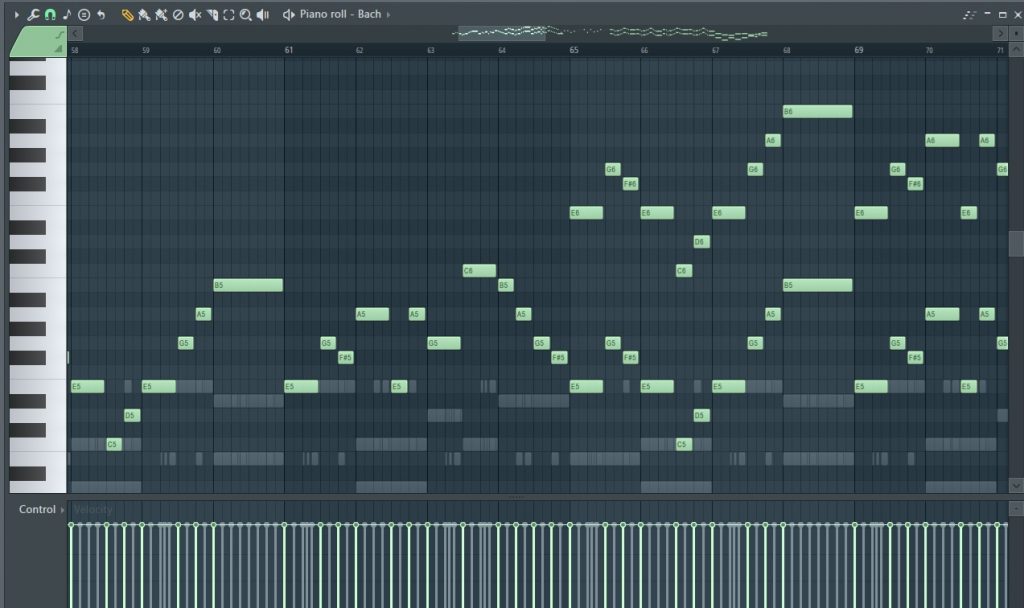
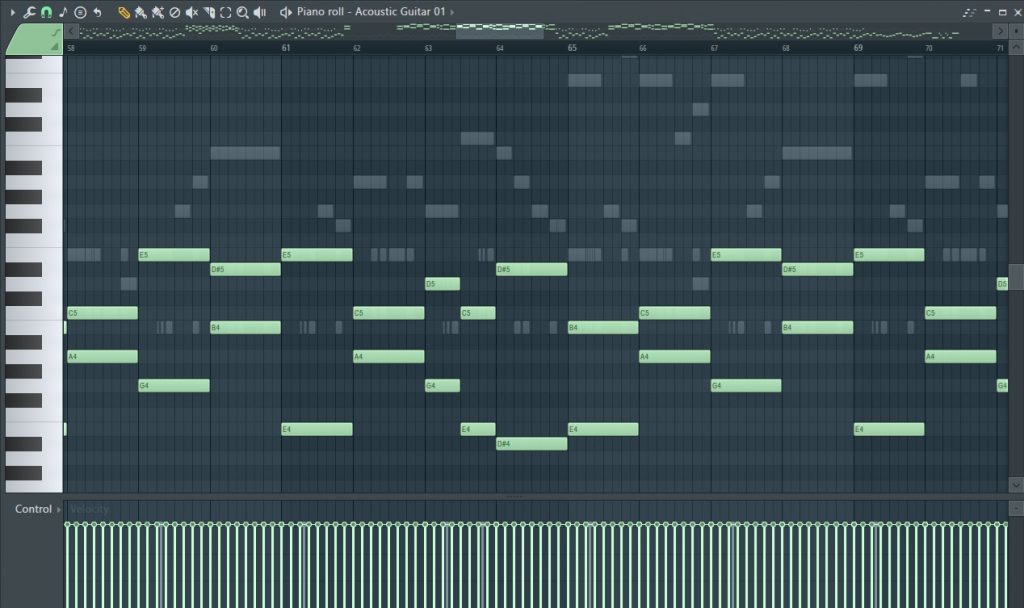
One day, it would be nice to set up a bunch of pianola type things with sets of piano rolls for different instruments in Grim tracks, and let them play. It would be a way of taking the digital back to the analogue, which is the opposite of what we’re all doing with DAWs.
I expect a clever person has already done something like that for an exhibition or art gallery somewhere. I’m not going to ‘google’ it, I can’t be arsed.